“When it starts getting hot. That’s when you plant the okra seeds,” so says my big brother Jermaine, who we call Maine.
We were at my poetry reading at All Good Books in Columbia, South Carolina. Wanting the audience to have a sensory experience that went beyond auditory and desiring to engage a different sense, I brought food. So much of my book Traveling Mercy includes food, and so the sense of taste seemed appropriate.
We had pileau/perlo, fried chicken, fried okra, and some of Maine’s collard greens. Along with the cooked food, I also bought some of Maine’s dried okra pods that contained seeds. He gave me a bunch of them, and I had been using them as decoration for my book displays.
Okra is a central symbol in Traveling Mercy. The green okra along with the yellow flowers that are sometimes the precursor to the manifestation of the fruit are abundant on the cover of the book. I had been offering the pods to people and saying, “If you plant the seeds, they will grow.” At this poetry reading I had repeated the phrase, and someone asked when to plant them, which prompted my brother’s response.
When spring/early summer arrived in SC, I decided to do something I had never done before: Plant my own okra.

Jermaine has the green thumb in the family. He inherited from our father LJ. Our father’s father was Felix Bartell, and according to my aunt, Grandaddy Felix kept a vegetable garden too. I imagine that his father did too and his father before him, so that in our own special way, we are keeping alive the tradition of growing food to feed your family. A skill I imagine our family has cultivated for centuries, even in the soil of a village in Africa, a village whose name we will never know.
My brother was my guide on my okra journey. Telling me how to plant the seeds.
I started the seeds in a pot, moved some of them to a small plot of land, and left one in a big pot. We have small patio and little yard area, but I managed to clear off some space.
The key to okra is making sure they have enough water in the summer humidity. They need fertilizer as well. Like us, plants need food and water.
The stalks began to shoot up higher and leaves came, then the beautiful yellow flower came. And soon I had some okra.
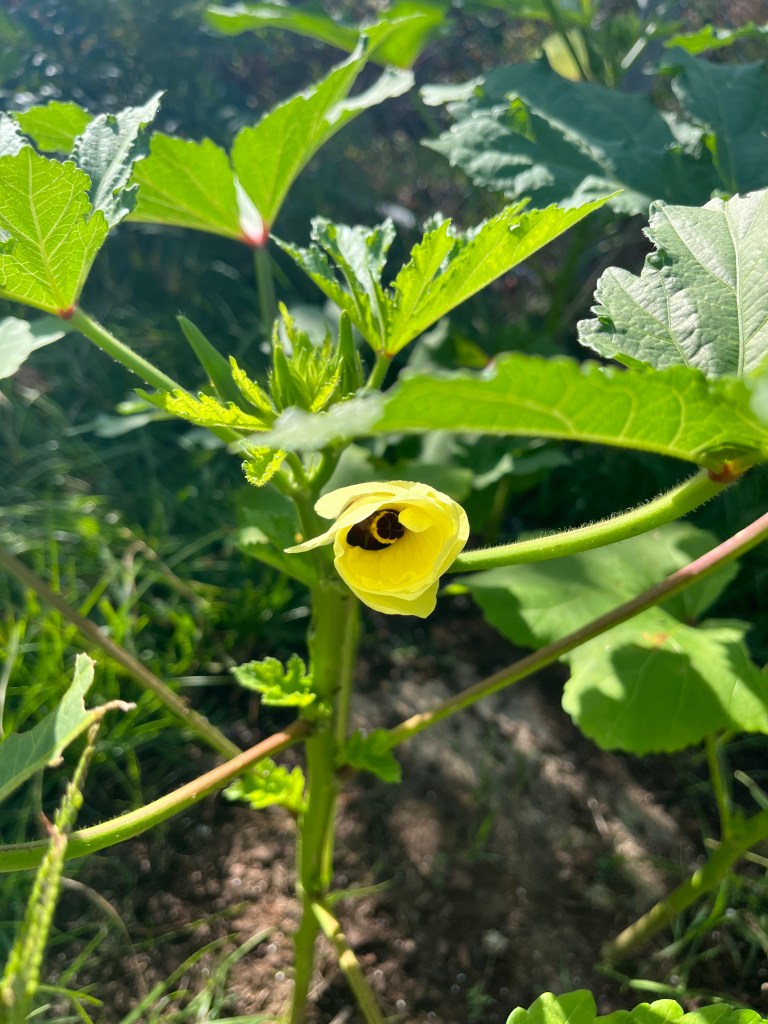
The grasshoppers and ants enjoyed the okra a little too much, even when I applied the Neem oil Maine suggested.
As with my growing a tomato plant journey, I expanded out of the fixed mindset of, “Oh, well! I just don’t have a green thumb,” and most importantly, I had an expert who helped me along the way.
I ended the summer with a small crop of okra. Just enough to fry with some breading. I didn’t have the traditional cowpeas and butterbeans with the okra on top. Our father would sometimes slice up the okras and fry them in a cast iron skillet. He didn’t mind their sliminess at all. Sometimes he would call them okrie/okree instead of okra. I have taught my son to say okrie, and helped me water them many days.
Our father died October 2011. He had already started his fall garden and had collard greens that were doing well. I marveled at those collards, that would continue to grow, although the hands that put them in the ground had been stilled forever. How our father would have the power to feed us even after he had died. These marvels would eventually become the poem “Leaves Like Prayer.” My brother Maine is in that poem; he plays a big role in my writing process of that poem.
The day after Da died, Maine went to Cox Feed Store and brought some broccoli; he planted it in Da’s fall garden. I guess it was his way of being close to Da. To put his black hands into the black earth that our father had.
The next fall Maine planted collard greens. One day I was walking past the garden and looked at his greens—the leaves tight (a collard is a cabbage without a heart) but starting to spiral out, their little leaves looking like hands readying to clasp for prayer, which is the moment for the poet to pay attention. The hands clasping for prayer, the hands putting seeds and seedlings into the earth, the hands that have been stilled, graying in the grave, are the essence of “Leaves Like Prayer.”
Before I read that poem last winter at that poetry reading, I had the audience take out their small sampling of Maine’s collard greens, cooked with smoked turkey wings and not the ham hocks of the poem—we’re trying to eat a little healthier now. I told the audience to eat the collard greens and told them my brother had grown them and cooked them and was sitting in the audience with them, probably my first poetry reading he had ever been to.
We were eating Maine’s collard greens that our father taught him how to grow and our mother taught him how to cook. My brother Maine, a living legacy in one beautiful Black man who uses his hands to feed the folk he loves.
Happy Birthday, Maine. I love you.
 Jennifer Bartell Boykin
Leave a comment